
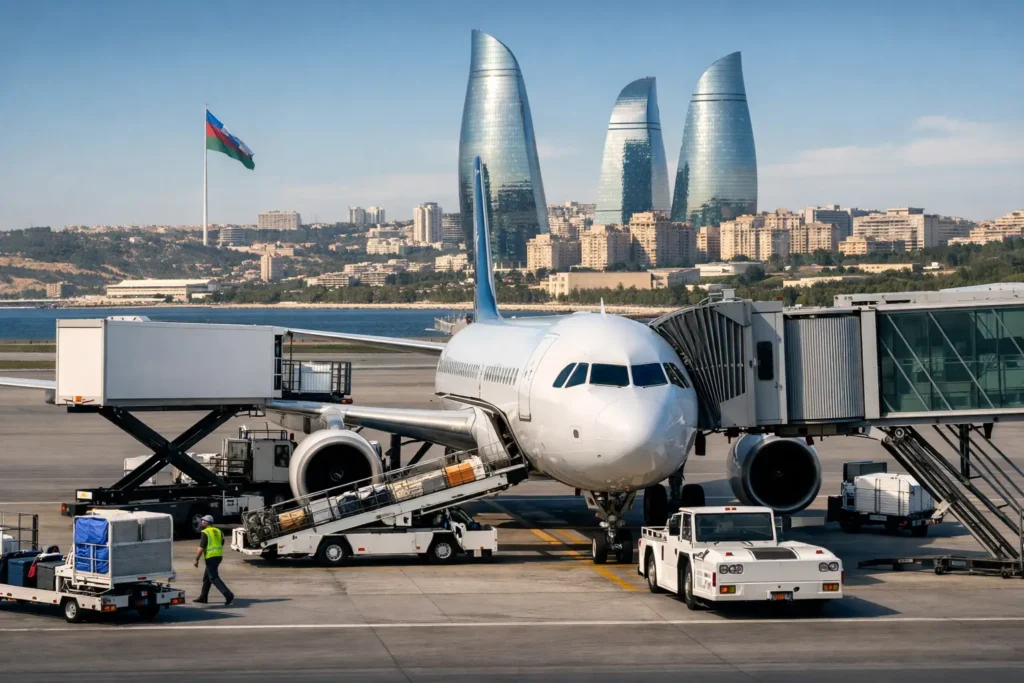
A delayed arrival, a last-minute rooming change, a speaker transfer that must be re-routed before wheels-down – this is where baku ground handling services stop being a line item and start becoming the part of your product that protects margin, timing, and client confidence.
For travel agencies, tour operators, OTAs, and MICE planners, Azerbaijan is rarely sold as a stand-alone airport transfer and hotel package. It is sold as a managed destination product that has to work from arrival to departure. That means meet-and-greet at Heydar Aliyev International Airport, correctly timed transfers, contracted hotels that match the brief, guides who understand both destination storytelling and group handling, and an operations team that can keep multi-day programs moving across Baku and the regions without friction. The local partner matters because the ground operation is the product your client actually experiences.
What baku ground handling services really cover
In trade terms, ground handling is not a single service. It is the operational framework behind inbound delivery. In Baku, that typically starts with airport arrival management and extends into accommodation coordination, transportation planning, sightseeing execution, dining reservations, guide allocation, and support for amendments while the program is live.
For FIT business, the emphasis is speed, accuracy, and flexibility. You need quick quotation turnaround, clear inclusions, and the ability to adjust vehicle size, meal arrangements, or excursion timing without rebuilding the file from scratch. FIT passengers may have private requirements, premium hotel expectations, or short city-stay windows that leave little room for misalignment.
For series and group tours, the pressure shifts. Manifest handling, rooming lists, luggage flow, restaurant capacity, coach dispatch, and guide consistency become central. A well-priced itinerary on paper can still fail if airport coordination is slow or if one late service causes a knock-on effect across the day.
For MICE programs, the scope widens again. Ground handling may include VIP protocols, hospitality desks, branded staffing, gala transportation sequencing, technical movement between venues, and tighter reporting lines to agency project teams. In that setting, reliability is not only about logistics. It is about protecting your own brand in front of a corporate client.
Why agencies evaluate Baku ground handling services differently
Baku is straightforward to sell when the destination partner understands how trade business is built. The challenge is not access to attractions or hotel inventory alone. It is how efficiently those pieces are assembled into a saleable, repeatable product.
International partners usually assess a local DMC on four points. First is response time. If a quotation takes too long, the opportunity often moves elsewhere. Second is rate logic. Trade partners do not need public-facing language or vague package totals – they need structured proposals that align with category, seasonality, and operational scope. Third is execution quality. A supplier may quote well but struggle when the program goes live. Fourth is communication. Problems are manageable when updates are timely and solutions are practical.
This is why the strongest local partners are not simply suppliers. They operate as an extension of the agency’s operations desk. They understand that every missed transfer, every guide mismatch, and every poorly timed dinner reservation reflects on the seller in the source market, not just the company on the ground.
The operational difference between simple handling and dependable delivery
Many destination services look similar in a checklist. Airport transfer, hotel booking, city tour, guide. The difference shows up in the operating detail.
Dependable delivery starts before arrival. Flight tracking should feed into transfer planning. Rooming lists should be checked against final manifests. Special requests should be passed to hotels in a way that is confirmed, not assumed. City touring should be routed according to realistic traffic patterns and attraction timing, especially in programs where Baku sightseeing is combined with Absheron or Gobustan.
The next layer is resource control. A local partner handling inbound business at scale needs stable transport access, multilingual guide coverage, and practical hotel relationships across multiple categories. Not every request needs luxury inventory, and not every group should be routed into the same standard restaurant rotation. The right fit depends on source market, budget band, and program purpose.
Then there is contingency management. A strong ground handler does not eliminate change. It absorbs it. If a flight is late, the arrival flow is adjusted. If a meeting runs over time, transport sequencing is revised. If weather affects a regional excursion, the itinerary is rebalanced with a sensible alternative. That is what agencies are actually buying when they appoint a destination partner.
Where Baku programs usually expand beyond the city
A Baku stay often works best as the anchor of a wider Azerbaijan program. For agencies building three- to six-night products, the city pairs naturally with the Absheron Peninsula, Gobustan, and selected regional extensions.
The exact mix depends on commercial intent. A short-break product may stay close to Baku and focus on city touring, heritage, and evening dining. A leisure series may add Gobustan and Absheron for broader sightseeing value. A higher-yield itinerary may combine the capital with mountain stays in Shahdag or Tufandag, while longer circuits may include Gabala, Shamakhi, Nohur Lake, Guba, or Sheki.
From a ground handling perspective, this matters because regional routing changes the operational model. Driving times, hotel category consistency, meal-stop planning, and guide handovers all need to be built into the program design. It is one thing to quote a regional circuit. It is another to execute it smoothly across different service points.
What to ask before appointing a local partner
If you are sourcing baku ground handling services for ongoing business, the right questions are practical. How fast can the team turn around FIT and group quotations? How are amendments handled after confirmation? Can they support both standard series business and tailor-made requests without slowing response times? Do they have destination coverage beyond Baku if your product expands? Can they manage multilingual guiding and different vehicle configurations for mixed program types?
It is also worth looking at planning discipline. Strong operators ask the right questions early – arrival patterns, guide language, room preferences, meal style, operating hours, pacing, and whether your client prioritizes sightseeing volume or overall comfort. This kind of detail does not slow the process down. It prevents costly assumptions later.
For MICE and corporate agencies, reporting lines are especially important. You want one accountable contact, clear escalation, and an operations team that understands event timing rather than only leisure touring. Conference transfers, executive movements, and social functions require a tighter rhythm than standard group sightseeing.
A partnership model works better than transactional buying
The most productive DMC relationships are not built file by file with no continuity. They are built through repeated cooperation, better forecasting, clearer product alignment, and growing trust in delivery. When a local partner understands your market, your client profile, and your preferred operating style, quotation quality improves and execution becomes more predictable.
That has commercial value. It reduces time spent re-briefing. It helps with sharper itinerary design. It supports more confident sales activity because your team knows what can realistically be delivered. For operators adding Azerbaijan to a broader regional portfolio, this kind of partnership reduces the barrier to scale.
Brilliant Travel approaches ground handling in that way – as an operational partnership rather than a one-off service request. For trade partners, that means tailored proposals, clear communication, and destination execution designed to support long-term account growth, not just a single movement order.
Why this matters for your Azerbaijan product
Azerbaijan has real potential across leisure groups, FIT, incentives, and short-break city programs. But potential only turns into repeat business when the local operation is consistent. Clients may remember the skyline, the heritage sites, the mountain air, or the dinner venue. Agencies remember whether arrivals were managed properly, whether the itinerary flowed, and whether the local team solved issues without drama.
That is the standard baku ground handling services should be held to. Not whether a supplier can technically provide transport and hotels, but whether they can support your sales effort with fast quoting, realistic planning, and calm execution on the ground.
If you are building Azerbaijan into your portfolio, choose the partner that makes your product easier to sell and safer to operate. That is usually the decision that pays back long after the first file is closed.