
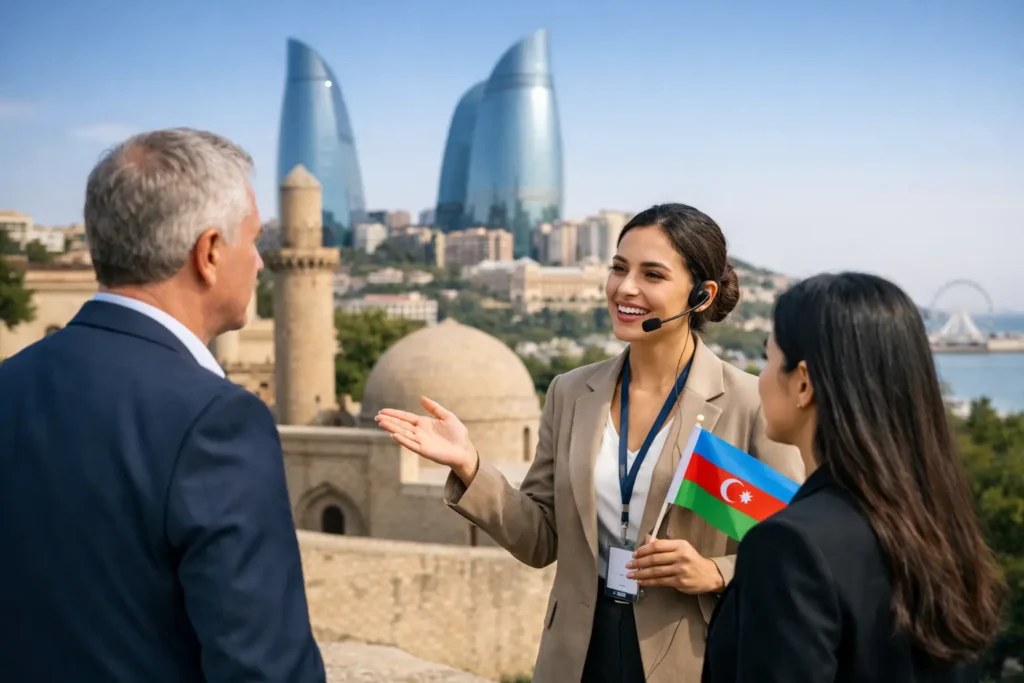
A Baku arrival can set the tone for an entire Azerbaijan program. When guests are met by a guide who speaks their preferred language, understands the operator’s itinerary, and can manage the pace of a mixed group, the destination feels immediately accessible. For travel professionals, multilingual tour guides in Baku are not simply an added service. They are a core part of product quality, guest satisfaction, and brand protection.
A guide is the person most visible to an agency’s clients after arrival. They explain the story behind Baku’s architecture, coordinate with drivers and venues, keep the itinerary moving, and handle practical questions with confidence. The right local guide turns a well-designed program into a well-delivered one.
Why multilingual guiding matters in Baku
Baku is a destination of contrasts that benefits from clear interpretation. A city program may move from the stone lanes of Icherisheher to the modern waterfront, then continue to the Absheron Peninsula for heritage sites and natural landmarks. Without thoughtful context, these stops can feel disconnected. A professional guide creates continuity, adapting the narrative to the group’s language, interests, and available time.
For international agencies and operators, language capability also reduces operational friction. Guests receive meeting instructions, timing updates, cultural explanations, and optional program details in a language they understand. This is particularly valuable for first-time visitors, incentive groups, senior travelers, and programs with a tightly managed schedule.
The value extends beyond translation. Strong multilingual guides understand how to interpret Azerbaijan for different travel styles. A leisure FIT may need a relaxed, conversational city introduction. A corporate incentive group may need crisp timing, polished presentation, and coordination with event planners. A series group may require consistency across multiple departures. The language is essential, but the operational judgment behind it is what protects the partner’s guest experience.
What travel partners should expect from multilingual tour guides in Baku
A professional guide service should begin well before the first sightseeing stop. The guide needs a complete operational brief: guest profile, preferred language, arrival details, hotel, transport plan, dietary or mobility notes supplied by the operator, itinerary sequence, and the desired level of commentary. Last-minute changes are part of ground handling, so the guide must also be connected to a local operations team that can respond quickly.
For Baku programs, the guide should be comfortable managing both interpretation and timing across a variety of settings. This can include airport meet-and-greet support, hotel briefings, panoramic city tours, Old City walks, waterfront programs, museum visits, restaurant coordination, and evening movements. For regional extensions, the same standard should continue through Gobustan, Gabala, Shamakhi, Sheki, Shahdag, Guba, and other itinerary points.
There is an important distinction between a bilingual escort and a destination-qualified guide. An escort may be effective for basic communication and group movement. A qualified local guide adds historical, cultural, and geographic knowledge, handles questions with accuracy, and understands how to present each stop in a commercially appropriate way. For product launches, premium FITs, incentive groups, and specialist itineraries, that distinction can be significant.
Language matching should follow the source market
There is no single “best” guide language. The correct fit depends on the selling market, group composition, and program complexity. English is often suitable for international corporate groups and mixed-language departures, while other language requirements may be central to the guest experience in specific markets.
The practical question is not whether a guide can speak a language conversationally. It is whether that guide can conduct a full day of professional commentary, manage service communication, and represent the operator’s program with confidence. Before confirmation, partners should clarify whether the group requires native-level fluency, a specific regional language preference, or an English-speaking guide with translated support materials.
For unusual language combinations or simultaneous language needs, early planning matters. A single coach group may require more than one guide, or a lead guide supported by a language host, depending on the program design. This adds cost and coordination, but it can be the right choice when guest comprehension and program quality are priorities.
Guide allocation for FIT, groups, and MICE programs
Guide planning should match the operating model rather than follow a one-size-fits-all approach. FIT travelers often benefit from a private guide who can adjust the flow of the day, spend more time at preferred stops, and coordinate directly with the driver. This format works well for premium leisure programs, executive travel, and family itineraries where flexibility is part of the product promise.
For series groups and coach tours, guide allocation is more structured. The guide needs clear service timing, hotel coordination, restaurant schedules, attraction entry planning, and a reliable transport team. Group size, walking pace, language needs, and the number of included visits all influence how the day should be staffed. Large groups may require additional guide support to maintain audibility, comfort, and efficient movement at busy sites.
MICE and incentive groups require another level of coordination. A guide may support pre-event tours, spouse programs, gala transfers, off-site excursions, and delegate assistance while working around conference schedules. In this environment, presentation standards and timing discipline are as important as destination knowledge. The guide should know who makes operational decisions on site and how to escalate changes without interrupting the guest experience.
Building guides into the itinerary, not adding them at the end
The strongest Azerbaijan programs are designed with guide operations in mind from the quotation stage. A city tour that looks efficient on paper may need revised timing for hotel departures, traffic patterns, walking distances, meal service, or venue access. Local input helps shape a route that is engaging and deliverable.
For example, a Baku and Absheron day can combine key city viewpoints with a heritage-focused peninsula extension, but the order of visits should reflect the group’s hotel location, meal timing, and preferred pace. A Gobustan program requires different planning considerations from a mountain extension to Shahdag or a cultural circuit toward Sheki. The guide’s local perspective helps ensure that the narrative, transport, and guest energy remain aligned.
This is also where a DMC adds value for trade partners. The guide should not operate in isolation. They need direct coordination with dispatch, drivers, restaurants, hotels, attraction contacts, and the account manager handling the file. When every service supplier works from the same confirmed itinerary, changes can be managed clearly and the operator has one accountable local point of contact.
The briefing process that protects service quality
A concise but complete guide briefing is one of the most effective tools in ground handling. It should identify the operator or agency brand to be represented, the client profile, language requirement, arrival and departure times, confirmation numbers where relevant, and all included services. It should also clarify what should not be presented as included, particularly where optional arrangements are handled separately by the originating partner.
The guide benefits from knowing the purpose of the trip. A leisure group celebrating a milestone, an incentive delegation, a familiarization group, and a corporate meeting group may visit similar places, but they need different pacing and communication. A capable guide adjusts the delivery while remaining consistent with the agreed program.
Post-service feedback is equally useful. It helps identify whether language matching, timing, commentary depth, or group management should be refined for future departures. For operators running recurring Azerbaijan series, this feedback loop supports more consistent delivery over time and makes expansion easier.
A reliable local extension of your team
Travel partners sell more confidently when their local guide service is supported by disciplined operations. The aim is not to make every itinerary identical. It is to make each confirmed program clear, appropriately staffed, and professionally executed from airport arrival through departure.
Brilliant Travel supports multilingual guiding as part of coordinated Azerbaijan ground handling for FIT, group, and MICE programs. Guide allocation can be planned alongside transport, hotel services, excursions, and regional routing, giving partners a practical framework for tailored proposals and repeatable delivery.
The most effective guide is often the one guests barely need to think about: present at the right moment, fluent in the right language, informed without being intrusive, and fully aligned with the program your team has promised. That level of local execution gives agencies and operators room to grow Azerbaijan with confidence.