
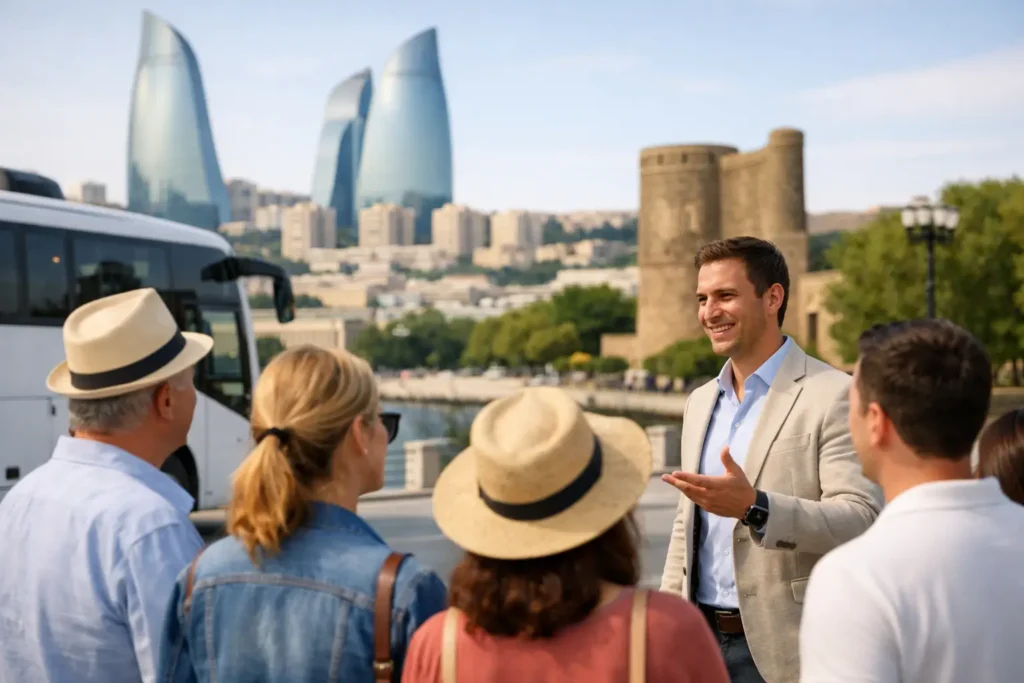
A successful Baku city tour for groups is not defined only by its sightseeing list. It is defined by how well arrivals, rooming, coach movements, guide timing, meal reservations, and guest pacing work together on the ground. For travel agencies, tour operators, and MICE planners, Baku is a highly saleable city product when the program is structured around operational reality rather than a generic checklist of attractions.
The city can support short stopovers, dedicated weekend breaks, incentive programs, pre- and post-conference touring, and longer Azerbaijan circuits. The key is to match the route, transport plan, and service level to the group profile from the quotation stage onward. A dependable local DMC turns that process into a clear, controlled program that protects both the guest experience and the partner’s reputation.
Why Baku Works for Group Programs
Baku gives operators a distinctive capital-city experience in a compact touring area. The medieval streets of Icherisheher, the waterfront setting of Baku Boulevard, contemporary architectural landmarks, and the wider Absheron heritage landscape provide enough contrast for a two- to four-night program without requiring long daily transfers.
For group business, this matters because travel time affects more than guest comfort. It affects meal windows, venue access, guide working schedules, coach positioning, and whether an evening function begins on time. A well-designed Baku itinerary can combine cultural heritage, panoramic viewpoints, contemporary city scenes, and hosted dining while maintaining a realistic pace.
The city is also adaptable across source markets and travel purposes. Leisure series may prioritize landmark touring and free time in central areas. Corporate incentives may require a sharper balance of branded experiences, private venues, executive transport, and schedule discipline. Conference groups often need modular tours that can operate before sessions, after sessions, or as optional extensions for delegates and accompanying guests.
Building a Baku City Tour for Groups Around Flow
The strongest group itineraries organize the city by geography and timing, not by the order attractions appear in a brochure. Baku’s Old City and central boulevard area work naturally together, while the upland viewpoints and modern districts should be scheduled with traffic patterns, event timing, and meal locations in mind.
Arrival Day: Keep the First Impression Controlled
Arrival day requires restraint. Even when flight schedules allow an early check-in request or an immediate city orientation, a full sightseeing program may not suit every group. Flight origin, guest age profile, luggage handling, and hotel readiness should shape the first-day plan.
A practical approach is a meet-and-greet at Heydar Aliyev International Airport, dedicated transfer coordination, hotel check-in support, and a light evening component if timing permits. This could be a hosted dinner, a short panoramic drive, or a carefully timed walk in a central area. The purpose is not to fill every hour. It is to establish confidence, provide clear information, and begin the program without avoidable pressure.
For larger arrivals, the ground handler should confirm vehicle allocation, luggage capacity, group leader contact details, welcome signage, and dispatch sequencing before the flight lands. These details are rarely visible in an itinerary, but they are often what guests remember when a program begins well.
Core City Day: Heritage, Views, and Modern Baku
A full-day city program commonly centers on Icherisheher, Baku’s historic core. Its narrow lanes, heritage architecture, and landmark sites offer a strong cultural foundation, particularly when presented by a professional multilingual guide who can adapt the commentary to the group’s interests and available access time.
From there, the program can move toward the waterfront and central city. Baku Boulevard provides an effective transition between the old and new parts of the destination, while a panoramic stop in the Highland Park area frames the city’s relationship with the Caspian coast and its changing skyline.
Modern Baku can be included through exterior visits, architectural orientation, or an event-linked stop, depending on the group’s priorities. The right balance depends on the brief. A heritage-focused leisure group may prefer extended guided time in the Old City, while an incentive group may value a more dynamic city drive with carefully selected photo moments and a private meal or reception element.
The itinerary should also allow for practical realities. Historic areas are best experienced on foot, so mobility needs must be identified early. Larger coaches cannot always wait directly at every sightseeing point, which makes designated pick-up locations and guide-led transitions essential. Groups with limited walking capacity can still enjoy a strong city program, but routing and stop duration should be adjusted rather than treated as an afterthought.
The Operating Details That Protect the Program
A city tour is a visible product, but its reliability depends on planning that happens before guests arrive. Agencies and operators should expect their local partner to clarify the group size, hotel location, flight schedule, language requirements, rooming pattern, special meal needs, and preferred touring tempo before finalizing services.
Transportation is not simply a vehicle category. It is a capacity and movement plan. A smaller private group may need executive vans and a flexible departure window. A series group may require full-size coaches, coordinated guide systems, multiple vehicle dispatches, and a group leader seat plan. MICE movements can involve separate arrivals, VIP transfers, equipment vehicles, and timed shuttles between hotels and venues.
Guide allocation is equally important. The guide is the on-the-ground representative of both the DMC and the selling partner. Language capability, experience with large groups, destination knowledge, and confidence in managing transitions all affect the guest experience. For large parties, dividing the group into manageable sections with dedicated guides can improve audibility, reduce waiting time, and make heritage areas more enjoyable.
Meal planning should be integrated with the touring route. A restaurant may be excellent, but it is not the right operational choice if it creates an unnecessary cross-city transfer or cannot accommodate a group within the required service window. Group menus, dietary requests, seating plans, and timing should be confirmed in advance, especially when a program includes a gala dinner, themed evening, or incentive recognition event.
Extending the City Product Beyond Central Baku
A Baku stay becomes more commercially flexible when operators can add half-day or full-day extensions without rebuilding the entire itinerary. The Absheron Peninsula is particularly useful for this purpose. A heritage route can combine the Ateshgah area and Yanar Dag, while a longer excursion can incorporate Gobustan and the mud volcano landscape as a separate regional experience.
These additions should not be automatically placed into every group program. A two-night city break may benefit more from a concise Baku orientation and quality free time. A three- or four-night leisure series can support a full Absheron or Gobustan day. For incentives, the choice may depend on whether the client wants cultural content, open-air activities, private hospitality, or simply more time for the main event agenda.
The operational advantage of a locally managed program is that extensions can be quoted as modular components. This allows the agency or planner to package a base itinerary and offer optional touring, or to create distinct versions for different departure dates, budgets, and group objectives without losing control of service standards.
MICE Requirements Need a Different Layer of Planning
MICE city programs are not leisure itineraries with a conference hotel added to them. They require more detailed coordination across venues, production teams, delegate movements, registration schedules, and event run sheets.
A Baku city tour for groups attending a meeting or incentive should be built around the event agenda first. If a conference ends at 5:00 p.m., the tour must account for delegate release time, vehicle loading, evening traffic, and dinner service. If a gala uses an off-site venue, transfer schedules, host staffing, signage, and return departures need to be planned as one movement, not as separate supplier tasks.
Brilliant Travel supports this process through integrated ground handling: hotel coordination, transport logistics, multilingual guides, restaurant and venue arrangements, and day-by-day operational oversight. For international planners, a single local point of contact reduces the risk of fragmented communication and makes last-minute adjustments easier to manage.
What to Include in a Group Tour Inquiry
The fastest route to an accurate proposal is a complete brief. At minimum, share travel dates, estimated group size, flight details if available, preferred hotel category or contracted property, language requirements, meal requirements, and the purpose of travel. For MICE inquiries, include the provisional event agenda, venue needs, branding or production requirements, and VIP movement expectations.
It also helps to define what success looks like for the client. Is the priority a competitive city-break package, a premium incentive experience, maximum sightseeing within limited time, or a conference program with reliable delegate logistics? Those objectives influence the right itinerary far more than a standard list of attractions.
A well-run Baku program gives partners more than a city tour to sell. It gives them a repeatable Azerbaijan product with clear operations behind it, room to tailor the experience, and a local team ready to carry the delivery standard their clients expect.