
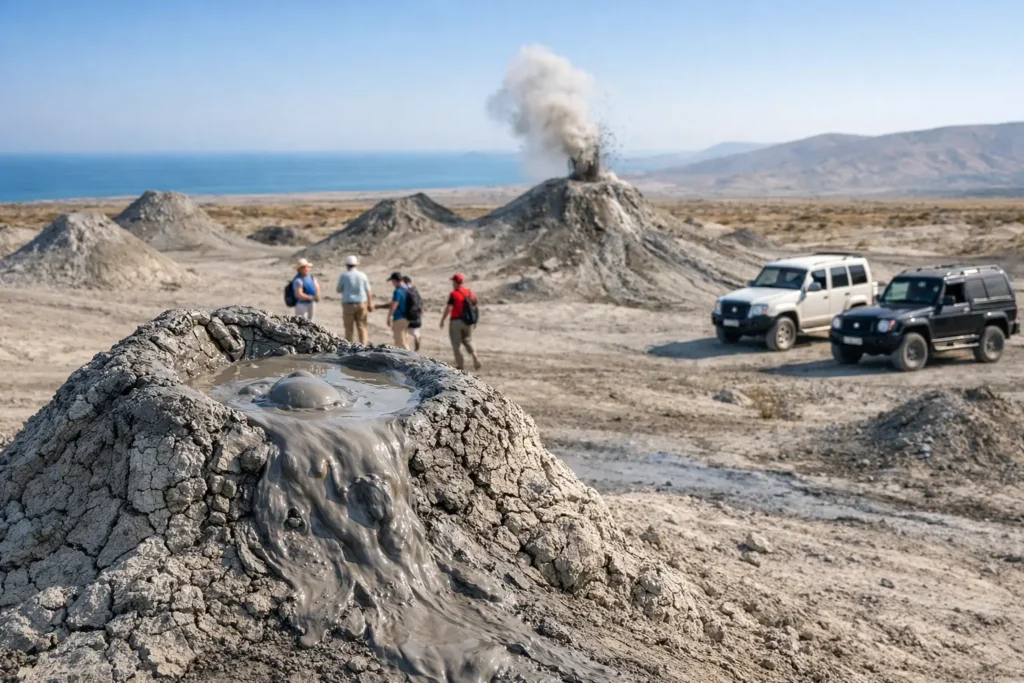
A Gobustan mud volcano day tour is one of the most commercially useful half-day or full-day products an Azerbaijan operator can place alongside a Baku stay. It combines a UNESCO-listed cultural landscape, a geological experience that clients rarely encounter elsewhere, and a route that can be scaled for FITs, series groups, and incentive programs without requiring an overnight stay.
For travel professionals, the value is not only in the destination itself. The product works because it can be delivered with clear timings, appropriate vehicle planning, strong guide interpretation, and flexible add-ons that fit different source-market expectations. When these elements are handled correctly, Gobustan becomes more than a photo stop – it becomes a distinctive Azerbaijan itinerary anchor.
Why Gobustan Performs Well in Azerbaijan Programs
Gobustan sits within practical touring distance of Baku, allowing agencies to add meaningful heritage and nature content without complicating hotel operations or intercity logistics. The usual program centers on the Gobustan Rock Art Cultural Landscape, where prehistoric petroglyphs, archaeological context, and the museum experience provide a structured cultural foundation before the route continues toward the mud volcanoes.
This pairing matters. The rock art site gives guides a strong narrative about early human life, trade routes, and the landscape of the Absheron region. The mud volcanoes then shift the day into a visually striking natural setting. Clients receive two distinctly different experiences in one excursion, making the program easier for agencies to position as a premium cultural add-on rather than a simple sightseeing transfer.
A well-paced day tour is especially effective for first-time visitors to Azerbaijan, short-stay city breaks, and pre- or post-event MICE extensions. It also complements Baku city touring because the contrast is immediate: urban architecture and Caspian waterfront views give way to open terrain, ancient carvings, and an otherworldly geological landscape.
Building a Gobustan Mud Volcano Day Tour That Operates Smoothly
The operational design should begin with the client profile and the desired duration. For many FIT and small-group itineraries, a half-day format can cover the museum, petroglyphs, and mud volcano area with a focused schedule. A full-day version allows more relaxed interpretation, a lunch arrangement, and optional route extensions depending on the overall program design.
The transfer to the mud volcanoes requires particular attention. Road access near the site can vary by route and local conditions, so operators should plan the final approach with suitable locally sourced vehicles rather than assuming a standard coach can complete every section comfortably. For private clients and smaller groups, this may mean arranging a vehicle change near the access point. For larger series, careful dispatch planning and staged vehicle movements protect both timing and client comfort.
This is where an experienced local DMC adds practical value. The itinerary may look simple on paper, but the quality of the day depends on coordinating departure times, guide briefing, appropriate transport, museum entry flow, and realistic stop durations. A rushed visit can make Gobustan feel fragmented. A well-managed sequence lets the guide connect the archaeological story to the volcanic landscape and gives clients sufficient time for photography without delaying the wider Baku program.
Recommended program flow
A typical full-day format begins with a morning departure from Baku, timed to avoid compressing the museum visit. The group first visits the Gobustan museum and rock art area, where a professional guide can place the petroglyphs in context rather than treating them as isolated images on stone.
The tour then continues to the mud volcano area using the planned local access arrangement. After time at the site, the return route can include a lunch stop or an optional Caspian-side or Absheron element where it supports the itinerary. The final routing should be based on hotel location, group pace, meal requirements, and any evening commitment such as a gala dinner, conference session, or airport transfer.
For a half-day option, the same core elements can be retained with a tighter operating window. This format is often suitable for clients who have already completed Baku city touring or for corporate groups with limited free time. The trade-off is depth: a shorter program leaves less room for extended storytelling, lunch, and additional stops.
Guide Quality Turns a Scenic Stop Into a Sellable Experience
Gobustan should not be operated as transport plus admission. The petroglyphs require interpretation, and the mud volcanoes benefit from a concise explanation of Azerbaijan’s geological setting and the phenomenon clients are seeing. Without this context, the excursion can feel like two unrelated stops.
Multilingual guide allocation should therefore be confirmed early in the quotation process, particularly for series groups and incentive departures. The guide needs to manage the practical rhythm of the visit while adapting the narrative for the audience. A leisure FIT may prefer a conversational pace and time for photography. A large group may need clearer movement instructions, designated regrouping points, and a shorter but compelling commentary that keeps the schedule intact.
For MICE planners, Gobustan can also support branded or themed experiences when planned appropriately. The destination is best used as an authentic offsite excursion rather than overproduced entertainment. Thoughtful touches such as pre-arranged refreshments, guide receivers for larger groups, coordinated vehicles, and a well-timed meal service can elevate delivery while preserving the character of the site.
Transport Planning by Group Size
Vehicle selection is central to a dependable Gobustan operation. Sedans and vans can suit FITs and executive travelers, while minibuses and coaches support larger groups for the main route from Baku. The final access to the mud volcanoes should be planned separately, with the most appropriate local vehicle solution confirmed for the group size and program date.
For groups, the key question is not simply how many seats are needed. It is how the group will move through each stage of the experience. A large coach group may require a coordinated transfer arrangement for the final section, along with a guide and tour leader briefing that clearly sets expectations. This reduces idle time and keeps the program professional from hotel departure through return.
The same principle applies to family groups, senior travelers, and VIP delegations. Their requirements may differ, but the underlying standard is consistent: transport should be matched to the route, the guest profile, and the schedule. Building this into the proposal from the outset prevents last-minute changes that can affect both margin control and service perception.
Positioning the Tour for Different Product Lines
A Gobustan program has wide application, but it should not be sold identically across every itinerary. For classic Baku city breaks, it works best as a signature excursion that adds heritage and landscape contrast. For Caucasus combinations, it provides a clear Azerbaijan-specific experience before clients continue to another destination. For incentive travel, it can become a memorable daytime component between formal business sessions and evening events.
Operators serving culturally motivated travelers may emphasize the museum, rock carvings, and historical narrative. Those building visual, experience-led products can lead with the mud volcano landscape while ensuring the heritage site remains integral to the day. For family-oriented itineraries, pacing, vehicle comfort, and manageable walking time deserve more attention than extended archaeological detail.
Seasonality also influences program design. Morning starts are generally preferable for an unhurried visit, especially when combining Gobustan with other Baku-area elements. In warmer periods, agencies may favor earlier departures and a fuller midday break. In cooler months, the route can be framed around the clarity of the open landscape and the comfort of a well-sequenced indoor museum visit followed by outdoor stops.
Quoting With Operational Clarity
A strong B2B quotation should distinguish between the core excursion and the variables that affect delivery. Group size, guide language, vehicle category, meal requirements, access transport, entrance arrangements, and optional extensions all influence the final program structure. Clear inclusions help agencies compare formats accurately and present the right version to their clients.
For recurring departures or contracted series, early forecasting supports more consistent guide and transport planning. For ad hoc FIT requests, responsive confirmation and a realistic schedule are often more valuable than an overly ambitious routing plan. Agencies benefit when the local operator identifies what can comfortably be delivered in the available time and proposes alternatives where needed.
Brilliant Travel structures Gobustan and Absheron programs around this operational reality, combining local transport coordination, professional guides, and itinerary execution through a single point of contact. The objective is straightforward: give agency partners a distinctive Azerbaijan product that is easy to sell and dependable to deliver under their own brand.
The best Gobustan day tours leave clients with more than photographs of bubbling earth and ancient stone. They leave with a clear sense that Azerbaijan offers experiences their standard city-break portfolio cannot easily replicate – and that the ground operation behind those experiences is under control.