
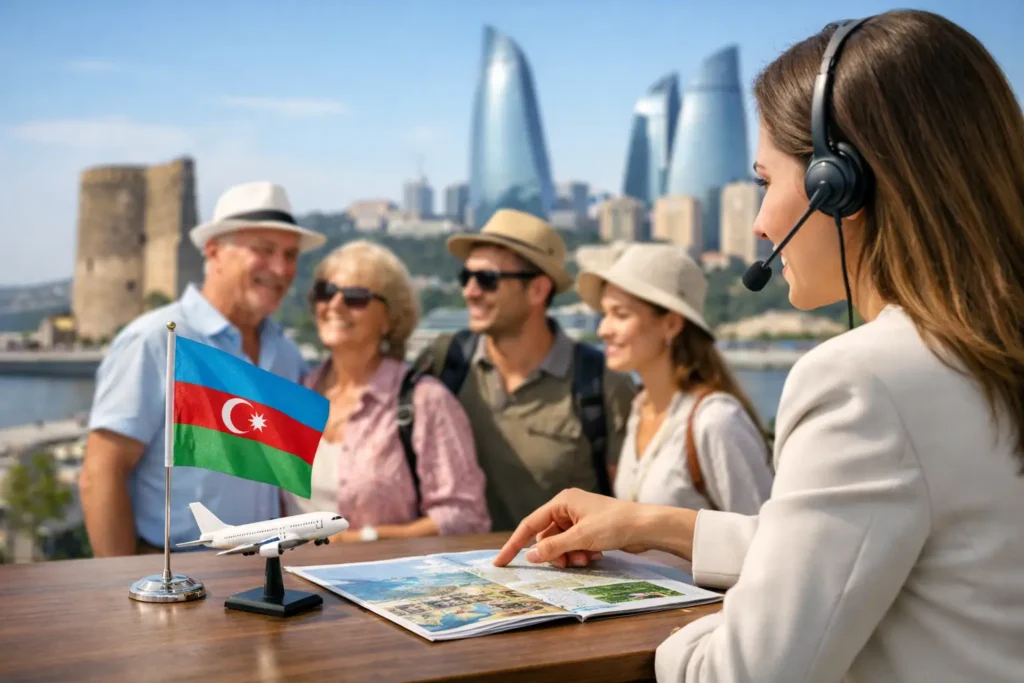
A group arriving at Heydar Aliyev International Airport does not judge an overseas operator by the itinerary PDF. It judges the operation by what happens in the first 30 minutes: whether the coach is positioned, the guide is briefed, rooms are ready, and the welcome feels organized. That is where Azerbaijan group tour operator support becomes commercially valuable. For an international agency or tour operator, local execution is not a back-office detail. It is the part of the product that protects the brand promise made to every traveler.
Azerbaijan has strong potential for leisure series, special-interest departures, incentives, and corporate groups. Baku combines contemporary architecture, Caspian waterfront experiences, and heritage programming, while regional routes add mountain resorts, lakeside landscapes, food experiences, and historic towns. The opportunity is clear. The operational question is whether a local partner can turn that opportunity into a repeatable, accurately costed, well-managed group product.
What Azerbaijan group tour operator support should include
A capable destination management company should support the full chain of delivery, from the first request for proposal through departure-day coordination. For group business, this means far more than confirming a hotel and vehicle. The local team needs to understand the operator’s market, group profile, routing priorities, inclusions, service standards, and commercial deadlines before building a workable program.
The most useful support begins with a clear brief. Group size, travel dates, rooming pattern, preferred hotel category, meal requirements, language needs, flight schedule, and the desired pace of travel all influence the proposal. A student group, a premium leisure departure, and an executive incentive may visit similar places, but they require very different service design.
The DMC should then translate that brief into a detailed ground arrangement covering accommodation, transfers, sightseeing, guides, entrances where requested, meals, and operational timing. The proposal should make assumptions visible rather than burying them. Clear inclusions, exclusions, hotel alternatives, and release conditions give the outbound partner the confidence to present the program accurately to its own client.
Fast quotation turnaround matters, but speed without accuracy creates problems later. The better approach is a prompt initial response followed by precise confirmation of availability, routing, and operational feasibility. This is especially relevant for high-demand dates, large room blocks, and multi-city programs where the itinerary depends on coordinated regional services.
The operational details that protect your brand
Group travel is often won or lost in small transitions. A well-planned Baku arrival may require vehicle staging based on passenger count and baggage volume, guide deployment by language, airport meet-and-greet instructions, hotel check-in coordination, and a realistic transfer time before the first activity. If a late arrival is followed by an early city tour, the schedule needs to account for the actual guest experience, not just the distance on a map.
The same principle applies outside the capital. A route through Gobustan and the Absheron Peninsula can be designed as an efficient day program when timing, attraction order, meal stop, and traffic patterns are considered in advance. A multi-day circuit through Shamakhi, Gabala, Nohur Lake, Sheki, Guba, or Khinalig requires even closer coordination between transport, regional hotels, guides, and local experience providers.
This is why one point of operational ownership matters. When separate suppliers are left to coordinate independently, the outbound operator may spend valuable time chasing updates across time zones. A DMC account manager should hold the working plan, confirm service status, manage amendments, and provide a clear escalation route while the group is in destination.
For white-label partners, this structure also preserves the customer relationship. The local operation works as an extension of the tour operator’s product team, with communications and service delivery aligned to the agreed brand standards.
Transportation is capacity planning, not simply transfers
Vehicle selection should reflect more than headcount. Luggage levels, road routing, guide seating, mobility needs, and the amount of time guests will spend traveling all affect the right solution. A compact city group and a multi-day mountain itinerary may call for different vehicle configurations even with the same number of passengers.
An experienced ground handler plans transportation with practical contingencies in mind. This includes appropriate pickup windows, clear driver dispatching, route sequencing, and realistic service hours. For larger series, the transport plan should be reviewed against each departure rather than copied unchanged from one season to the next.
Guides shape the program’s perceived quality
A multilingual professional guide is both a host and an operational leader. The guide connects the story of the destination to the group’s interests, keeps timing on track, and communicates changes calmly when required. For trade partners, language availability should be confirmed early, particularly for less common language requests or simultaneous groups.
A strong guide briefing is just as important as guide assignment. The guide needs the final itinerary, hotel details, meal arrangements, guest profile, special requests, tour leader contact, and escalation procedure. This preparation reduces avoidable questions on the road and creates a more consistent guest experience.
Building itineraries that sell and operate well
The most attractive itinerary is not necessarily the one with the most stops. Groups need a program that balances signature experiences with breathing room, particularly after flights or on long touring days. A four-night Baku-centered program can combine the Old City, modern landmarks, Gobustan, mud volcanoes, Ateshgah, and Yanar Dag with appropriate pacing. A longer itinerary can add Gabala, Shahdag, Tufandag, or Sheki for a broader destination story.
The right structure depends on the source market and the purpose of travel. Leisure groups may prioritize sightseeing and free time. MICE groups often need a precise combination of airport management, meeting support, gala logistics, private venues, and selected excursions. Incentive groups may require more tailored moments, while an operator running a scheduled series needs a program that is repeatable across multiple departures.
There is a trade-off between customization and operational efficiency. Highly individual programs can create standout experiences, but they require early planning and a reliable chain of confirmations. Standardized core itineraries are easier to scale and cost consistently, then can be enhanced with market-specific elements. The best local support helps the partner decide where customization adds real value and where it adds complexity without improving the group experience.
Hotel contracting and room-block confidence
Accommodation is one of the largest variables in a group quotation. Hotel category alone is not enough. Operators need to know the practical fit: room inventory, twin and double availability, meeting space if needed, coach access, location, breakfast flow for groups, and the feasibility of early or late operational requirements.
A DMC with active local contracting can advise on suitable hotel options and present alternatives when requested dates are constrained. For series business, early forecasting and allotment discussions can provide greater planning certainty. For ad hoc groups, the priority is often a fast, transparent availability check with clearly stated conditions.
It is also helpful to separate what is confirmed from what is proposed. This prevents an itinerary from being sold as fixed while key components remain subject to availability. That discipline may feel cautious, but it protects both the tour operator and the end client from unnecessary changes later.
MICE support requires a different level of control
MICE programs are group operations with a higher concentration of moving parts. Registration flow, conference equipment, branded materials, production schedules, delegate transfers, private dinners, and optional activities must work around a fixed event agenda. A delay in one element can affect the whole program.
For this reason, MICE planners benefit from a local team that can build a detailed operational run sheet rather than simply confirm individual services. Site inspections, venue comparisons, transport manifests, staffing plans, and supplier briefing documents become central working tools. The DMC should be prepared to coordinate closely with the planner’s production or events team while maintaining a single, accountable point of contact on the ground.
Brilliant Travel supports these requirements through B2B ground handling designed around the operator’s own program and client commitments. The aim is practical: give partners a dependable local structure, not a generic destination package.
Questions to settle before confirming a group
Before final confirmation, a productive operator-DMC discussion should establish four areas: the exact group profile, the status of flights and hotel space, the operational priorities, and the communication process. The first avoids mismatched assumptions. The second clarifies which elements are firm and which remain pending. The third identifies where the program needs extra control, such as VIP handling, multiple languages, accessibility considerations, or event production. The fourth ensures that everyone knows who approves changes and who receives real-time updates.
It is also wise to agree on a final service timeline. This should cover name-list deadlines, rooming-list format, dietary requirements, guide language confirmation, arrival manifests, tour leader contacts, and payment or voucher procedures according to the commercial agreement. These details are routine, but routine is exactly what a reliable group operation should feel like.
Azerbaijan is easiest to sell when the destination story and the delivery plan are equally strong. The right local partner gives your team accurate proposals, grounded itinerary advice, and accountable execution from airport arrival through final departure. That leaves you free to focus on your client relationship, knowing the group is supported by people who understand what the program promises and what it takes to deliver it.