
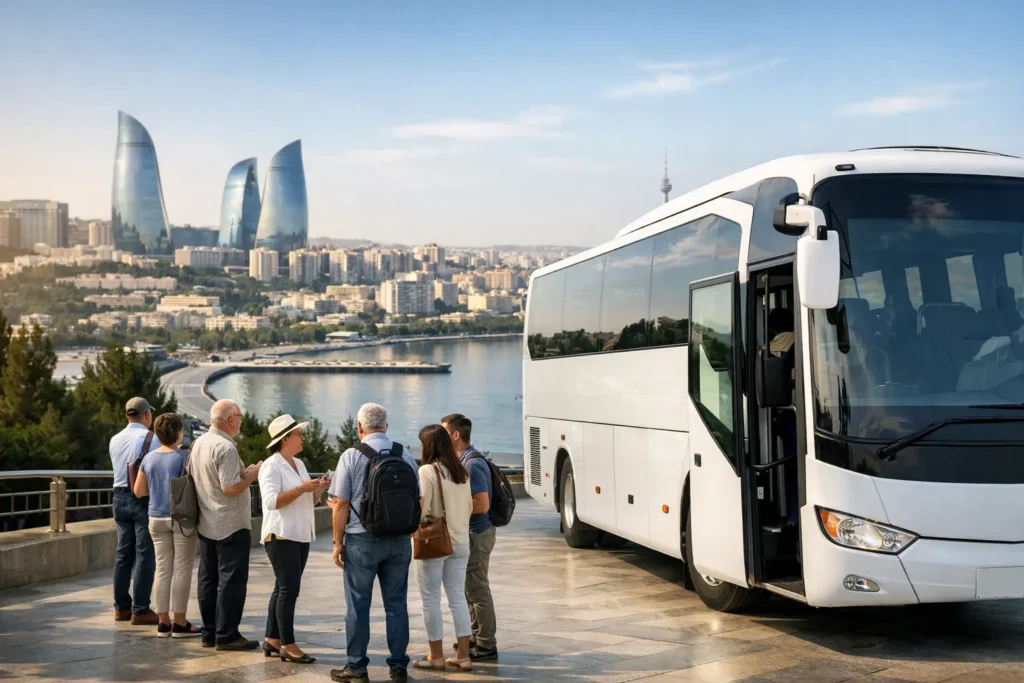
A strong Azerbaijan program can lose momentum in the first hour if arrival transfers, vehicle allocation, and guide timing are not aligned. For agencies and operators, Azerbaijan transport for tour groups is not simply a coach reservation. It is the operating framework that keeps an itinerary on schedule, protects the guest experience, and gives the selling partner confidence that every movement is being managed locally.
A practical transport plan must account for group size, luggage volume, flight schedules, hotel access, daily driving patterns, and the pace expected by the source market. It must also remain flexible enough to support a late-arriving delegation, a revised site inspection, or a MICE program that requires multiple vehicle movements at the same time.
Start with the itinerary, not the vehicle
The correct vehicle is determined by the program before it is determined by the headcount. A group of 20 guests on a Baku city stay has different requirements from 20 guests traveling with full luggage on a multi-night circuit through Shamakhi, Gabala, Sheki, and mountain resorts. A corporate incentive group may require executive sedans for VIPs, a dedicated luggage vehicle, and separate shuttles between a hotel, conference venue, and gala location.
For this reason, the transport brief should be built alongside the itinerary. Key operational details include arrival and departure flight numbers, the number of bags per traveler, hotel locations, guide language requirements, meal stops, timed attractions, and whether the group will return to the same hotel each night. This early planning avoids common pressure points, such as assigning a vehicle with insufficient luggage capacity or creating an unrealistic day of sightseeing around traffic and travel time.
For standard leisure series and ad hoc groups, the core fleet mix generally includes sedans, minivans, minibuses, and full-size coaches. The goal is not to place the largest available vehicle on every movement. Right-sizing protects comfort, manages operating costs, and gives the guide room to manage the group effectively.
Arrival transfers at Heydar Aliyev International Airport
Airport handling sets the tone for the full program. For groups arriving at GYD, a transport plan should specify the meet-and-greet point, lead guest or tour leader contact, vehicle order, guide assignment, luggage handling process, and transfer departure sequence. On larger arrivals, guests may be released from the terminal at different times, so the team needs a clear system for keeping the group together without delaying the entire operation unnecessarily.
Flight monitoring and real-time communication matter most where multiple flights converge. A capable local operations team can coordinate vehicle dispatch with actual arrival status, rather than relying solely on scheduled timing. The same discipline applies to departure transfers, particularly for programs using several hotels, VIP movements, or early-morning flight banks.
Azerbaijan transport for tour groups beyond Baku
Baku and the Absheron Peninsula support compact half-day and full-day touring, including Gobustan, mud volcanoes, Ateshgah, and Yanar Dag. These programs still need precise routing. Attraction opening times, parking arrangements, meal service, and hotel departure timing can affect how comfortably a group completes the day.
Intercity circuits require another layer of planning. Routes toward Shamakhi, Ismayilli, Gabala, Nohur Lake, Guba, Khinalig, Shahdag, Tufandag, Sheki, Ganja, Lankaran, and Naftalan should be designed around the intended pace of the group, not only the map distance. A family-oriented leisure group, a senior delegation, and a high-energy incentive program may follow the same broad route while needing very different departure times, rest breaks, and sightseeing durations.
For multi-day tours, the most effective approach is to retain the same vehicle and crew where the itinerary permits. It gives guests continuity, reduces daily handover risks, and allows the driver and guide to understand the group rhythm. Where regional access, capacity requirements, or program design call for a vehicle change, that exchange should be planned as an operational handover, with luggage counts, guide coordination, and clearly confirmed timing.
Mountain and seasonal program design
Mountain resorts at Shahdag and Tufandag add strong value to Azerbaijan group products, especially when paired with Baku and Gabala. They also benefit from realistic transport sequencing. Rather than treating a resort visit as a quick stop inserted between multiple distant attractions, build enough time for the road journey, resort activities, meal service, and photo opportunities.
Seasonal planning is equally useful. In cooler months, group programs can be structured around appropriate departure windows and mountain stays. In warmer periods, early starts can create a more comfortable flow for outdoor heritage and nature visits. The local transport plan should support the itinerary objective, whether that is leisure touring, an incentive experience, a familiarization trip, or a conference extension.
What reliable ground handling looks like
Transport quality is judged by much more than the condition of the vehicle. Agency partners need a single local point of contact who can confirm changes quickly, align drivers and guides with the final operation sheet, and keep the wider program moving when schedules change.
A disciplined transport operation begins with reconfirmation. Before arrival, the DMC team should validate flight data, rooming and passenger lists, final hotel details, guide language, vehicle assignments, and special movement requests. Drivers should receive clear operating instructions rather than a broad itinerary with missing timings. Guides need access to the same current schedule so that they can manage guests with confidence.
During the program, communication needs to be practical and fast. A group may finish a museum visit early, encounter a busy restaurant service period, or need an additional hotel-to-venue shuttle. The operations team must be able to assess the available options, coordinate the right resource, and communicate a clear solution to the partner or tour leader.
This is particularly important for white-label delivery. The local operator is representing the agency’s product in the destination. Every clean vehicle, informed driver, timely transfer, and well-briefed guide helps protect the agency’s client relationship.
Transport planning for MICE and incentive movements
MICE transportation is often more complex than leisure touring because groups do not always move as one unit. Delegates may arrive across several flights, speakers may require private transfers, and program elements can run concurrently. A conference may need continuous shuttles between hotels and a venue, while an evening event requires staged departures and a controlled return schedule.
The operating plan should distinguish between dedicated transfers, shuttle loops, standby vehicles, and VIP transport. It should also establish who has authority to approve on-site changes. For a large event, a transport coordinator, vehicle manifests, driver briefing notes, and a movement desk can make the difference between a program that feels organized and one that feels improvised.
There is a cost trade-off. Holding standby capacity gives planners greater flexibility, but it must be matched to the event’s risk profile and budget. A tightly timed incentive or high-level corporate program may justify that capacity. A straightforward conference transfer schedule may be better served by a carefully planned shuttle rotation. The right answer depends on guest profile, venue layout, flight pattern, and the consequences of delay.
Questions to settle before confirming a group
Before issuing a final proposal, operators should clarify several points that directly affect transport quality. Confirm whether passenger numbers include tour leaders, children, staff, or local representatives. Ask about baggage expectations, mobility considerations, VIP requirements, and the desired guide language. Establish whether meals are fixed-time services or flexible stops, and whether the itinerary includes evening programs that extend beyond standard touring hours.
It is also wise to identify split movements early. One group may need separate airport departures, optional excursions, or a free afternoon with only some guests joining a dinner transfer. These details are manageable when included in the operation sheet from the outset. They become costly and disruptive when discovered on the day of service.
Brilliant Travel approaches group transport as part of the full destination operation, coordinating airport handling, touring, regional circuits, guides, hotels, and event logistics through one local team. That integrated model helps partners receive a more accurate proposal and gives their travelers a consistent experience from touchdown to departure.
The most useful next step is to share the draft itinerary, group profile, travel dates, and flight pattern at quotation stage. With those foundations in place, transport can be planned as a reliable part of the product rather than a last-minute operational detail.