
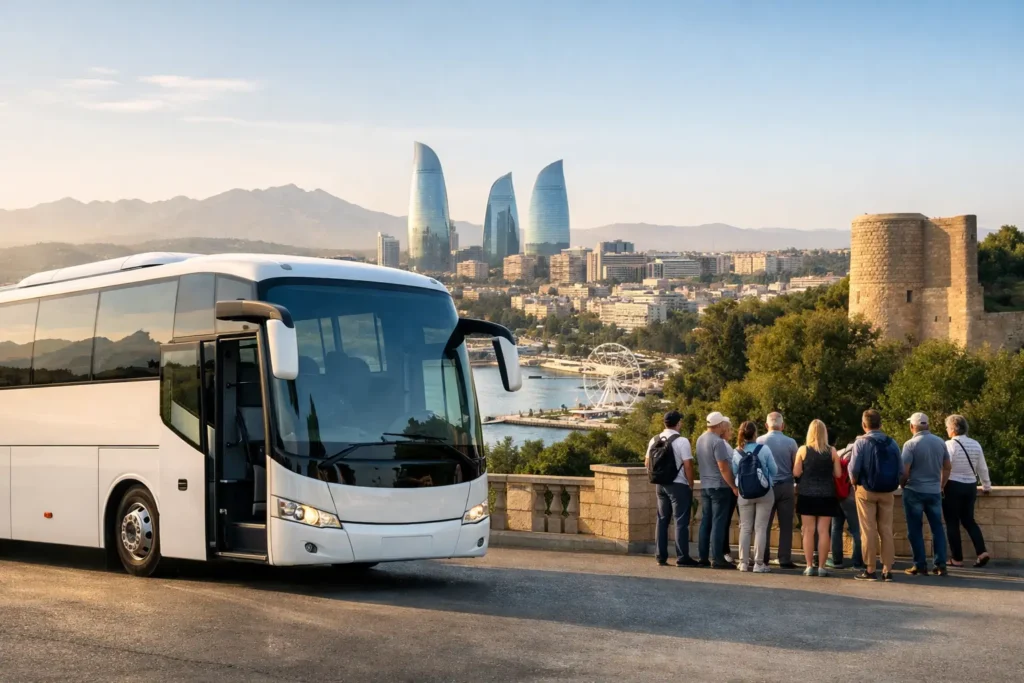
A 38-seat coach arriving five minutes late at Heydar Aliyev International Airport can affect more than an airport transfer. It can compress a city tour, delay a hotel check-in, disrupt a restaurant seating, and leave the tour leader explaining changes to guests before the program has properly begun. For agencies and operators, group transport is therefore not a standalone line item. It is the operating framework that keeps an Azerbaijan itinerary on time, commercially viable, and consistent with the service standard promised to the client.
A dependable local DMC plans transport around the full movement of the group: flight details, luggage volumes, hotel access, guide schedules, meal slots, attraction timing, and the practical distance between each stop. The objective is simple: travelers should experience a well-paced program, while the selling partner retains confidence that every ground component is being managed locally.
Why group transport needs program-level planning
Transport decisions made only on passenger count often create avoidable pressure later. A vehicle that appears suitable on paper may not allow sufficient luggage capacity, may be poorly matched to a long regional route, or may create an awkward split between the coach and a support vehicle. The right plan considers the group profile as well as its size.
A corporate incentive group, for example, may need coordinated airport meet-and-greet, branded arrival handling, a luggage plan, and timed movements between a hotel, conference venue, dinner location, and evening activity. A leisure series may prioritize efficient seat capacity, rotating guide commentary, and realistic driving times across a multi-day circuit. Educational groups may require more frequent comfort stops and careful coordination at heritage sites.
These differences affect vehicle allocation, staffing, dispatch timing, and contingency planning. They also affect the itinerary itself. A strong ground handler will flag when a program is trying to fit too much into one day, then propose an operationally sound alternative before the group arrives.
Selecting the right vehicle mix for group transport
The most appropriate vehicle is rarely determined by headcount alone. Large coaches work well for standard touring groups and airport movements with aligned flight schedules. Mid-size coaches can be more practical for smaller delegations, regional touring, or programs where hotel access and urban maneuverability matter. Vans and premium sedans are useful for VIPs, speakers, pre-arrivals, late departures, and operational staff.
Luggage is the factor most commonly underestimated. A group arriving for a short Baku stay may travel light, while an international incentive delegation or a multi-country Caucasus itinerary can arrive with larger cases, equipment, and special materials. When capacity is tight, arranging a dedicated luggage vehicle can protect guest comfort and avoid departure delays at the airport.
Vehicle selection should also reflect the program’s rhythm. A full-day route from Baku through Gobustan and the Absheron Peninsula requires a different configuration from a two-night mountain extension through Shamakhi, Gabala, and Nohur Lake. For longer circuits, passenger comfort, driver rotations where required, planned stops, and realistic service hours matter as much as the number of seats.
Build transfers around actual flight operations
Flight schedules are a starting point, not the entire transfer plan. International arrivals can emerge over a broad window depending on baggage handling, group visa arrangements where applicable, and the time required for a tour leader to assemble guests. A well-managed arrival operation has clear meeting-point instructions, a staffed welcome process, confirmed vehicle positioning, and direct communication between the airport representative, guide, and dispatcher.
For departure transfers, the same principle applies. Pickup timing should account for hotel checkout procedures, loading time, traffic patterns, and the group’s airline and terminal requirements. Sending one oversized coach too early can create an unnecessarily long airport wait. Sending it too late introduces risk. The best timing is based on the specific movement, not a generic rule.
Route design is part of the transport solution
Azerbaijan rewards itinerary design that combines urban, heritage, mountain, and nature experiences, but each addition carries a transport implication. Baku city programs may combine the Old City, contemporary landmarks, waterfront stops, and museums within a manageable day when access and parking are considered. Gobustan and mud volcanoes require different routing and vehicle planning than a conventional city tour. Mountain programs toward Shahdag, Tufandag, or Gabala need travel times that support the guest experience rather than turn it into a long transit day.
The right approach is to map the route in the order guests will actually experience it. This includes hotel departure, attraction entry windows, guide-led touring time, meal reservations, restroom stops, and vehicle waiting arrangements. It also means avoiding unnecessary backtracking. A program can look attractive in a proposal and still feel rushed on the ground if the routing has not been tested operationally.
For multi-day programs, transport should connect naturally with hotel selection. An itinerary that places the group in the right overnight location can reduce daily driving and create more time for meaningful experiences. This is particularly valuable for regional circuits that include Gabala, Shamakhi, Sheki, Guba, or mountain resorts. The trade-off is that regional hotel availability and meeting requirements must be confirmed early, especially for larger groups and peak dates.
MICE movements require tighter control
MICE transport involves more than moving delegates from point A to point B. It often includes staggered airport arrivals, speaker transfers, site inspection movements, gala dinner shuttles, technical crew requirements, and return transfers after events end at different times. A single coach plan may be efficient for a sightseeing day yet unsuitable for a conference schedule with multiple hotels and departure waves.
A transport matrix is useful in these cases. It records each movement by date, time, passenger profile, pickup point, destination, vehicle type, guide or coordinator assignment, and operational contact. This document becomes the shared reference for the DMC team and the agency’s project lead. It also makes last-minute changes easier to implement without creating confusion across several suppliers.
For high-visibility events, an on-site transport coordinator adds practical value. The coordinator monitors boarding, communicates timing changes, directs vehicles, and keeps the event team informed. Guests see an organized movement; the partner receives clear control behind the scenes.
What reliable operations look like on the ground
Quality in group transport is often visible in small details. Vehicles should be clean, appropriately maintained, and allocated with enough capacity for the group and luggage. Drivers need confirmed route briefs, contact details, and timing instructions. Guides should know the vehicle plan before guests arrive, not during the first transfer. Hotel concierges, restaurants, and venues should receive accurate arrival information when group access or parking affects the schedule.
Communication is equally important. The agency or tour operator should have a single accountable contact who can confirm final transport details, respond to amendments, and coordinate across guides, hotels, and drivers. This does not eliminate change. Flight updates, delayed baggage, revised delegate lists, and altered event timings are normal parts of group operations. What matters is whether the local team can assess the change quickly and implement a clear solution.
At Brilliant Travel, transport planning is integrated with guides, hotels, excursions, and event logistics rather than handled as an isolated service. That structure gives partners one operational view of the program from arrival through departure, with local teams coordinating the details that affect the guest experience.
Briefing a DMC for a better transport proposal
The fastest way to receive an accurate quotation and operating plan is to share the information that shapes the movement plan from the outset. Group size and travel dates are essential, but the DMC also needs flight schedules, baggage expectations, hotel requirements, preferred vehicle standard, guide language, key program elements, and any VIP or accessibility considerations.
For MICE groups, include the event agenda, venue location, rooming pattern if multiple hotels are involved, and any off-site functions. For touring series, indicate whether the itinerary is fixed or open to operational refinement. A local partner can then recommend the right vehicle mix and routing instead of simply matching a coach to a passenger number.
Early communication is especially valuable when a program includes regional overnights, simultaneous movements, or seasonal mountain components. It allows transport, accommodation, and guide resources to be aligned before the proposal reaches the end client.
The most effective group programs feel unhurried even when they are highly coordinated. That result comes from transport planning that respects the itinerary, the guests, and the partner’s reputation at every stop.