
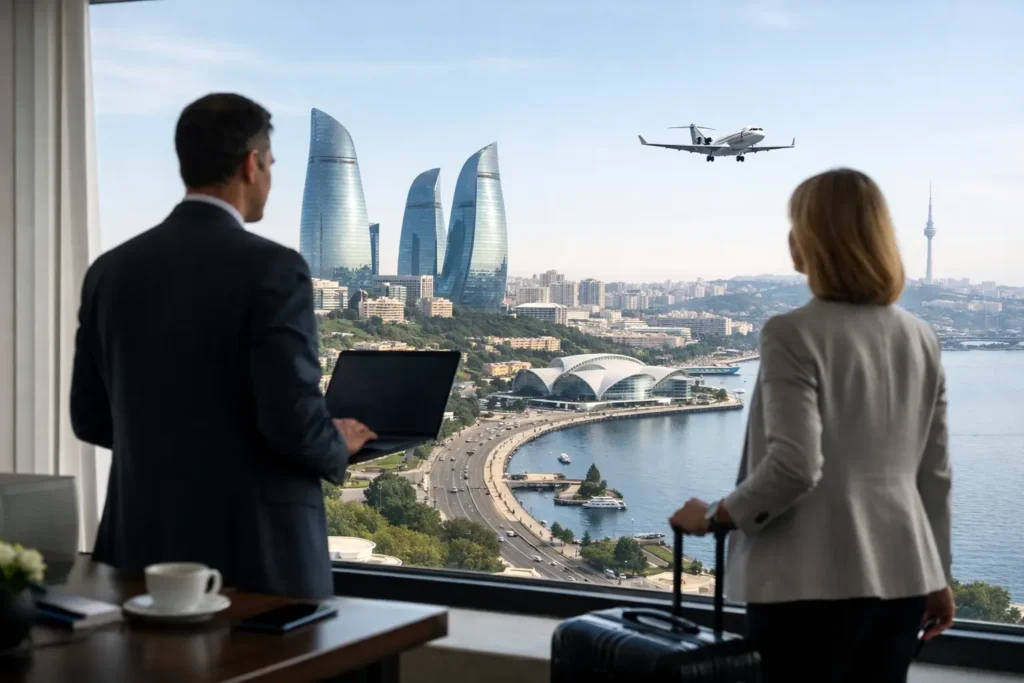
Azerbaijan corporate travel trends are moving beyond the standard city-break model. For agencies, corporate travel managers, and MICE planners, the opportunity is no longer simply to place a meeting in Baku. It is to build a program that combines efficient business infrastructure, distinctive regional experiences, and dependable ground handling under one controlled operating plan.
That shift matters because corporate groups judge a destination on more than the meeting room. They notice airport coordination, transfer timing, hotel flow, guide quality, dining logistics, and how quickly the program can adapt when an agenda changes. Azerbaijan can perform strongly across these points when the itinerary is designed around realistic routing and managed by an experienced local operations team.
Azerbaijan Corporate Travel Trends: More Purposeful Programs
The strongest corporate programs now give every element a role. A city hotel may provide the conference base, while an evening reception, heritage visit, or short excursion creates the shared experience that internal meetings alone cannot deliver. This is particularly relevant for incentives, leadership off-sites, dealer meetings, and reward groups that need a destination with a clear sense of place without sacrificing operational convenience.
Baku remains the natural hub for many programs. Its hotel inventory, event venues, airport access, and range of dining and cultural options make it suitable for short meetings, conferences, product launches, and pre- or post-event stays. For international planners, the practical advantage is concentration: arrivals, accommodation, meeting space, and many city experiences can be coordinated within a manageable operating area.
At the same time, planners are increasingly asking for programs that extend beyond the capital. Gobustan and the Absheron Peninsula can work well for half-day or full-day additions around a Baku conference. For longer incentives, the Gabala, Shamakhi, and Nohur Lake corridor offers a different setting for team activities, private dinners, and relaxed overnight stays. Mountain resort programs in Shahdag or Tufandag add another layer for groups seeking a more active or elevated incentive format.
The right choice depends on the group profile and the available time. A two-night executive meeting should not be overloaded with long road transfers. A four- or five-night incentive, however, can justify a regional circuit if hotel availability, luggage movements, meal timings, and transport rotations are mapped from the beginning.
Meetings Are Becoming Experience-Led
Corporate planners increasingly want a meeting agenda that feels intentional rather than interchangeable. A ballroom and coffee break package is still the core of many events, but the supporting program now carries more weight. Delegates remember the setting of a welcome evening, the ease of a hosted city visit, and whether their free time was well used.
For Azerbaijan, this creates room for carefully designed formats rather than generic sightseeing. A Baku program can pair a formal conference day with a guided Old City orientation, a private cultural evening, or an architectural route reflecting the contrast between historic and contemporary parts of the city. A regional extension can introduce nature, local food experiences, and lighter outdoor activities without turning a corporate itinerary into an unstructured leisure tour.
This approach also supports different meeting objectives. An internal leadership group may prefer private, low-distraction settings and a measured pace. A sales incentive may need more energy, visual impact, and shared activities. A multinational conference may prioritize multilingual staffing, clear signage, fast airport flow, and tightly managed delegate movements. The destination is flexible, but the operating plan must match the purpose.
Shorter Lead Times Require Faster Local Decisions
One of the clearest operational changes is the pressure on lead times. Agencies may receive a corporate inquiry with broad dates, an estimated group size, and only a preliminary brief. They still need a usable proposal quickly enough to protect the opportunity.
For a DMC, fast quotation turnaround is valuable only when it is supported by accurate availability checks and clear inclusions. A proposal should distinguish between confirmed, on-request, and alternative elements. It should also identify practical dependencies early, such as venue set-up requirements, rooming patterns, special transport needs, or regional hotel capacity during peak periods.
This protects the agency’s relationship with its client. A polished proposal that cannot be delivered creates more risk than a well-structured option that sets realistic expectations. Strong local handling means translating an early-stage brief into workable routing, suitable hotels, transport schedules, guide allocations, and contingency options before the program is presented as final.
One Destination, Multiple Group Formats
Azerbaijan is not a single-product MICE destination. The same ground network can support several types of business travel, provided each is treated differently.
A conference group requires disciplined airport dispatch, registration support, venue coordination, coach schedules, and staff who can manage high-volume movement. An incentive group needs more creativity in program design, but it also needs reliable timing, private event production, and detailed guest management. A smaller executive delegation may place the greatest value on discreet transfers, flexible schedules, and a knowledgeable local host.
This is why agency briefs should go beyond dates and headcount. The local operator needs to understand whether the group is traveling for recognition, training, strategic planning, networking, or a mixed business-leisure agenda. Dietary needs, language requirements, arrival patterns, VIP movements, meeting specifications, and desired activity levels all affect the final program.
When this information is provided early, it becomes easier to build a proposal that is commercially relevant and operationally credible. It also allows the agency to compare options on the factors that matter: program quality, service control, and fit for the end client, not just the headline destination list.
Regional Incentives Need Realistic Routing
The growing interest in regional experiences is positive, but it brings a trade-off. More destination coverage can improve an incentive program, while too much movement can reduce the time delegates have to enjoy it. The most effective circuits leave space for arrivals, check-ins, networking, and recovery between activities.
For example, Baku can serve as the principal arrival and meeting base, followed by a focused regional extension rather than a rushed cross-country route. Gabala and Shamakhi are often practical choices for groups that want scenic contrast after a city program. Guba and Khinalig can add a northern route for suitable group sizes and timing. Sheki can be positioned within a longer cultural itinerary, while Lankaran, Ganja, or Naftalan may suit more specialized program concepts.
Seasonality should shape the proposal without dominating it. Mountain experiences are especially valuable when matched to the group’s preferred activity level and the desired atmosphere. Urban meetings, heritage programs, and many regional routes can be structured across different periods of the year, with the itinerary adjusted around daylight, venue requirements, and group pacing.
The operational principle is simple: do not sell distance as variety. Sell a coherent journey in which each overnight, transfer, and experience supports the event objective.
What Partners Should Expect From Ground Handling
Corporate travel trends place greater scrutiny on the local delivery partner. Agencies need a single point of contact that can coordinate transport, hotels, guides, venues, restaurant reservations, excursions, and on-site staffing while keeping communication clear before and during travel.
For group movements, transport planning is more than assigning coaches. It includes flight monitoring, staged airport welcomes, baggage coordination where needed, vehicle rotation, driver briefings, timing buffers, and accurate dispatch information. For meetings and events, it also means aligning the event schedule with transfer windows, meal service, technical set-up, and evening program departures.
Multilingual professional guides and event staff are equally important. They provide more than commentary or directional support. They help maintain group flow, communicate schedule changes, support hosts, and ensure delegates receive a consistent standard of care throughout the itinerary.
Brilliant Travel supports this model with end-to-end Azerbaijan ground handling for corporate and MICE partners, from Baku arrival operations to multi-day regional programs. The goal is to give agencies and planners one accountable local team, clear proposal logic, and execution that protects their client relationship at every stage.
Designing for the Next Corporate Brief
The best response to the current Azerbaijan corporate travel market is not a fixed package. It is a well-managed framework: a strong Baku base, purposeful experience design, regional extensions where they add value, and an operating plan built around the realities of the group.
When preparing the next inquiry, start with the business objective and the non-negotiables before selecting excursions. A clear brief on group profile, preferred pace, meeting needs, and decision timeline gives the local team the information needed to turn Azerbaijan’s range of possibilities into a program that feels considered, controlled, and ready to represent your brand.