
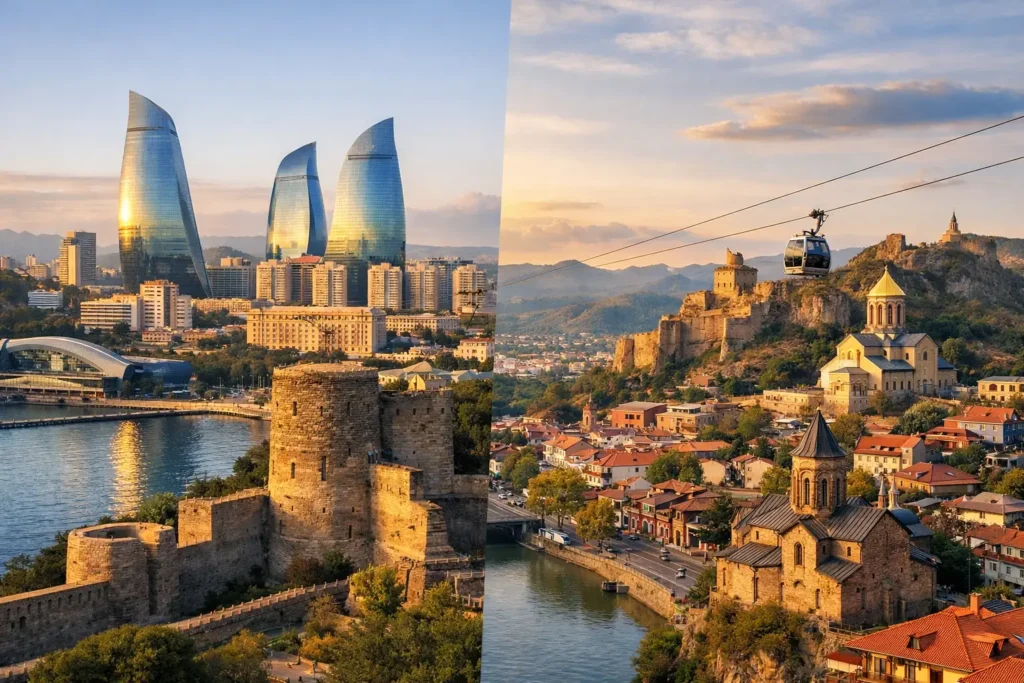
A Caucasus program is rarely won by simply adding more sights. It is won by matching the right destination rhythm to the operator’s source market, trip length, hotel standard, and service promise. When assessing Azerbaijan versus Georgia circuits, the useful question is not which destination is better. It is which circuit gives your clients a clearer reason to travel, while remaining efficient to quote, operate, and scale.
For many portfolios, Azerbaijan and Georgia work as distinct standalone products before they become a multi-country concept. Each has recognizable heritage, mountain landscapes, regional cuisine, and city experiences, but the pace, product emphasis, and operational design differ. A well-structured comparison helps agencies position each destination with confidence and avoid selling a program that feels over-routed or operationally uneven.
Azerbaijan Versus Georgia Circuits: The Product Difference
Azerbaijan is particularly strong when the program needs a polished capital-city base combined with short regional extensions. Baku delivers a concentrated mix of contemporary architecture, the Old City, Caspian waterfront settings, museums, shopping districts, and evening venues suitable for leisure groups and corporate programs. Beyond the city, Absheron heritage sites, Gobustan, mud volcanoes, Shamakhi, Gabala, Nohur Lake, Guba, and mountain resorts create varied touring without requiring a different operational approach in every location.
Georgia is often positioned around a more road-based discovery narrative. Tbilisi can anchor cultural touring, while regional programs may emphasize vineyard landscapes, historic towns, mountain scenery, and rural-style experiences. This can work very well for clients seeking a slower, more immersive itinerary with longer scenic drives and a broader spread of overnight stops.
The distinction matters commercially. Azerbaijan can be sold as a compact, high-impact destination with Baku at its center and strong contrast between urban, heritage, and mountain elements. Georgia may suit itineraries where the journey between regions is itself a larger part of the guest experience. Neither model is inherently superior. The right choice depends on the group profile and the operator’s preferred balance of touring time, hotel changes, and optional experiences.
Where Azerbaijan Has a Natural Advantage
For short-haul FIT programs, weekend extensions, and incentive departures, Azerbaijan’s circuit logic can be especially efficient. A three- or four-night itinerary can include Baku, Absheron, and Gobustan while preserving time for quality dining, retail, and unhurried city exploration. A five- to seven-night route can add Gabala, Shamakhi, Sheki, or Guba and Khinalig, depending on the desired landscape and hotel mix.
This structure is useful for agencies that need a clear product ladder. The entry program remains easy to understand and quote, while longer stays introduce mountain resorts, lakeside settings, cultural heritage, and regional accommodation. It also gives sales teams a strong upgrade path without making the base itinerary feel incomplete.
Azerbaijan is also well suited to premium corporate programs that require controlled timing. Baku offers the infrastructure for conference activity, gala dinners, city experiences, and branded offsite events, while Shahdag, Gabala, and other regional locations can provide an incentive-style contrast. The destination can move from formal business sessions to experiential touring without excessive hotel turnover.
Where Georgia May Be the Better Fit
Georgia can be a compelling choice when clients expect a more rural, culinary, and scenic-road-led experience. Operators building longer leisure itineraries may find that its regional geography supports a program where multiple landscapes and towns are central to the story. This is often attractive for small groups that value local atmosphere and are comfortable with a more mobile travel pattern.
That does not mean Georgia should automatically be assigned to every nature-focused request. Azerbaijan also has mountain, forest, lake, and countryside experiences, particularly across Gabala, Gusar, Ismayilli, Sheki, and the southern regions. The difference is in itinerary framing. Azerbaijan can combine nature with a highly developed capital base; Georgia may be presented more heavily through regional progression.
Circuit Length, Pacing, and Hotel Strategy
The most practical comparison is often made at the itinerary level rather than the destination level. Ask how many nights are available, how many hotel changes the group will accept, and whether the departure is leisure-led, corporate-led, or built around a special interest.
For a four-night program, Azerbaijan generally supports a clean single-country format. Two or three nights in Baku, paired with a full-day Absheron and Gobustan program or a regional overnight, can create a complete product. Trying to compress too many regions into that window reduces the value of the city experience and adds unnecessary coordination.
For six to eight nights, both destinations can support a richer standalone circuit. In Azerbaijan, an operator might combine Baku with Shamakhi and Gabala, then extend toward Sheki or the northern mountain corridor. The operational benefit is that transport, guide standards, meal planning, and hotel coordination remain under one local service framework throughout the program.
For longer Caucasus concepts, a two-country program can be commercially attractive, particularly for clients who want variety within one journey. The key is not to treat it as two short city breaks joined together. Build a genuine circuit with a logical arrival and departure pattern, sufficient time in each destination, and a clearly assigned DMC partner responsible for every service segment. Agencies should also confirm current entry and travel documentation requirements through the appropriate official channels before finalizing a departure.
FIT, Series, and Group Handling Considerations
FIT guests usually respond to clarity and flexibility. Azerbaijan can be packaged as a city-and-region product with private transfers, selected touring modules, multilingual guides, and a choice of hotel categories. This lets operators create short, mid-length, and premium versions from the same destination building blocks. It is a practical model for OTA partners and agencies that need repeatable proposals without making every file entirely bespoke.
For series groups, the operational focus shifts to coach routing, restaurant capacity, guide allocation, timed admissions where relevant, and hotel rooming patterns. A strong circuit should avoid treating every sightseeing stop as equal. The itinerary needs anchor experiences, realistic drive times, and enough free time for the group to absorb the destination rather than simply pass through it.
Azerbaijan’s Baku-centered operations can be helpful here. Airport arrivals through GYD, city hotel contracting, guide coordination, and regional transport can be managed through a single ground-handling plan. For groups moving into Gabala, Shahdag, Sheki, or Guba, advance coordination around room allotments and dining arrangements protects the operator from last-minute compromises during peak travel periods.
MICE Programs Need a Different Comparison
MICE planners should compare destinations through execution requirements, not sightseeing lists. Venue suitability, transfer timing, branded event logistics, group dining, VIP movements, production access, and contingency planning are central to the decision.
Baku is a strong option where a program needs an international-style city setting, conference infrastructure, premium hotels, and a concise incentive menu. A welcome reception in the city, a heritage excursion on the Absheron Peninsula, and a regional resort extension can create a balanced agenda for incentive groups. The program remains visually varied while retaining centralized control over transport and staffing.
Georgia may fit incentive briefs that prioritize a more dispersed countryside atmosphere or regional culinary programming. Yet a dispersed format requires disciplined planning around drive schedules, baggage movements, and hotel availability. For either destination, the operational question is simple: can the local team deliver the same service standard at every overnight and event point?
How to Position Azerbaijan Without Making It a Commodity
The strongest Azerbaijan proposals do not rely on a generic city tour followed by a generic mountain day. They establish a product story. Baku can be framed through its meeting of historic urban fabric and contemporary design; Gobustan and Absheron add heritage depth; Gabala and Shahdag introduce resort and landscape contrast; Sheki, Shamakhi, and Guba broaden the cultural and regional narrative.
This makes it easier for an operator to tailor programs by market. A family-oriented group may prioritize manageable touring, resort time, and lake or mountain scenery. A luxury FIT may prefer high-category Baku accommodation, private guiding, and carefully paced regional stays. A corporate group may require a formal Baku core with a memorable offsite component. The destination remains consistent, but the sequence and service level change.
For trade partners, this is where an experienced local DMC adds value beyond transport and hotel reservations. Brilliant Travel supports Azerbaijan programs through itinerary design, hotel contracting, multilingual guides, transportation, regional coordination, and end-to-end execution. The objective is to provide a proposal that is sellable at the front end and dependable once guests are on the ground.
Build the Comparison Around the Client Brief
Azerbaijan versus Georgia circuits should be assessed against the commercial brief: available nights, expected hotel level, preferred pace, group size, source-market expectations, and whether the program is leisure, series, or MICE. Azerbaijan is often the stronger answer for a compact, city-led program with high-quality regional contrast and efficient ground handling. Georgia may be better suited to a longer, regionally progressive itinerary where the road journey is part of the experience.
The most valuable next step is a precise request for proposal, not a generic destination comparison. When an agency shares dates, passenger profile, rooming, routing preference, and service standard, the local team can shape a circuit that protects both the guest experience and the operator’s reputation.