
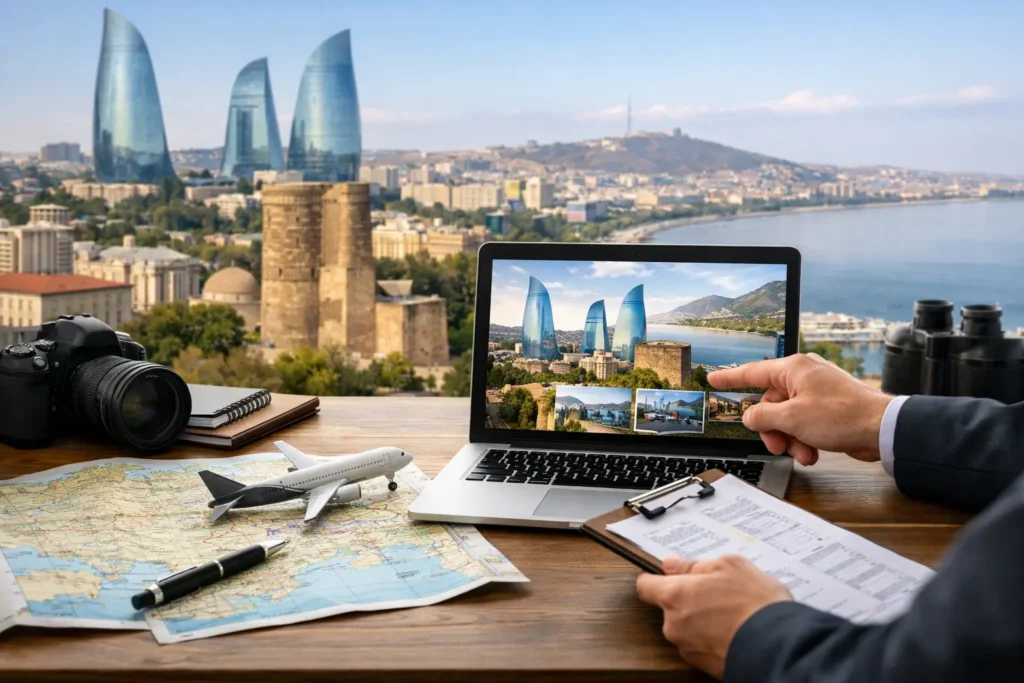
A profitable Azerbaijan product is not built by placing a few attractions into an itinerary. It is built through accurate timings, contracted inventory, clear inclusions, and an on-the-ground team that can execute exactly what your sales team has promised. This B2B Azerbaijan tour operations guide is designed for agencies, tour operators, OTAs, and MICE planners that need a dependable way to package the destination without carrying local operational risk.
Azerbaijan works particularly well as a flexible short-break and multi-day circuit destination. Baku delivers modern architecture, heritage, dining, and event infrastructure; the surrounding Absheron Peninsula adds cultural and geological sites; and regional routes provide mountain, nature, and wellness extensions. The commercial opportunity is clear. The operational question is whether every component can be delivered consistently for each market, group profile, and travel date.
Start With Sellable Azerbaijan Program Structures
The strongest B2B programs begin with defined route logic, not a generic list of places to visit. For most first-time itineraries, Baku should serve as the operational base. Arrival transfers from Heydar Aliyev International Airport, centrally located hotels, city touring, and a carefully paced excursion schedule create an efficient foundation for FIT and group business.
A three- or four-night Baku and Absheron program can combine the Old City, modern city landmarks, Gobustan, mud volcanoes, Ateshgah, and Yanar Dag. It is a commercially useful format for short-haul markets, weekend departures, incentive pre- and post-programs, and travelers adding Azerbaijan to a wider Caucasus journey. The key is not to overload the day. Gobustan and Absheron should be timed with traffic patterns, meal stops, guide commentary, and realistic transfer durations in mind.
For longer stays, a northwestern circuit can add Shamakhi, Gabala, Nohur Lake, and mountain experiences at Tufandag. A northern route toward Guba, Shahdag, and Khinalig offers a distinct mountain-led proposition. Sheki is appropriate for partners seeking a more heritage-focused extension, while Ganja, Lankaran, and Naftalan can support specialized regional, wellness, or longer-duration programs.
There is no single best route. A leisure group focused on sightseeing may prioritize Baku and Gabala, while a corporate incentive may need a refined Baku hotel, gala dinner logistics, a team activity, and one high-impact day excursion. The right program depends on flight schedules, group size, hotel standard, season, source-market preferences, and the pace your clients expect.
Build FIT Operations Around Control, Not Assumption
FIT business requires speed, but fast quotations should still be operationally complete. A proposal should identify the hotel category and room basis, private or shared transfer basis, vehicle type, guide language, sightseeing inclusions, meal requirements, and any special service requests. Ambiguity at quotation stage becomes a service issue on arrival.
Hotel contracting deserves particular attention. Properties that appear similar on a sales sheet can differ in room configuration, location, group policies, breakfast capacity, and ability to manage early arrivals or late departures. For an agency, the value of a local DMC is not merely access to inventory. It is the ability to recommend the right property for the itinerary and confirm details before they affect the guest experience.
Transportation should be matched to the actual operating plan. A sedan may suit a couple with light luggage, while a family, executive delegation, or small group may need a larger vehicle even if the passenger count appears modest. For regional circuits, vehicle comfort, luggage capacity, driver scheduling, and overnight routing matter as much as the transfer itself.
Professional guides are another core control point. A multilingual guide does more than deliver facts. They manage timing, meeting points, restaurant coordination, guest questions, and changes during the day. Agencies should specify language requirements early, especially for groups and peak travel periods, so guide allocation can be planned correctly.
Group Handling Requires a Different Operating Discipline
Group operations should not simply be treated as larger FIT files. Once passenger numbers increase, every moving part has to be coordinated as a system: rooming lists, luggage handling, airport meet-and-greet procedures, coach movements, restaurant capacity, guide deployment, check-in flow, and contingency communication.
A practical group proposal should clarify the tour leader policy, single-room requirements, meal arrangements, baggage assumptions, arrival and departure flight details, and the expected pace of sightseeing. For example, a group arriving on separate flights may need staggered transfers and a later welcome briefing rather than a single airport movement. A group with an early regional departure may need pre-arranged breakfast boxes or an adjusted hotel breakfast opening.
Coach planning also needs local judgment. The largest vehicle is not always the best answer if the itinerary includes city-center access, narrow approach roads, or frequent hotel movements. In some cases, a combination of vehicle sizes improves timing and guest comfort. This is where a ground handler protects the operator’s reputation: the visible program may look simple, but its execution depends on decisions made well before arrival.
Use MICE Design to Create More Than a Meeting Agenda
Azerbaijan can support meetings, incentives, conferences, and corporate groups when the program is structured around both business objectives and destination flow. Baku offers the hotel, venue, and transfer infrastructure needed for formal meetings, while nearby cultural and nature experiences can turn an agenda into an incentive-worthy program.
MICE planning should begin with operational questions: How many delegates are arriving? What are the flight waves? Is the event format theater, classroom, banquet, or cabaret? Are branding, registration, AV, interpretation, staging, or VIP protocols required? What does the group need between sessions to maintain energy without creating unnecessary travel time?
An effective incentive may combine a private city experience, a cultural heritage visit, an interactive team activity, and a well-managed gala evening. But creativity must remain workable. A memorable concept that requires difficult access, excessive transfers, or fragile timing can create pressure on the event day. Strong DMC planning balances visual impact with realistic logistics, supplier coordination, and a clear onsite command structure.
Create a Quotation Process Your Team Can Trust
The quality of an Azerbaijan quotation depends on the quality of the brief. Agencies can help accelerate turnaround by providing travel dates, passenger count, nationality mix when relevant to language planning, hotel category, rooming pattern, required services, guide language, flight details if known, and any dietary, accessibility, or VIP requirements.
In return, a capable local partner should provide a transparent program outline, confirmed or clearly stated availability status, precise inclusions and exclusions, and practical alternatives where a preferred service is not available. This matters especially for peak periods, large groups, and bespoke incentive requests. A quick answer is valuable only when it can be operated.
For repeat business, standardized program modules can improve speed without making every itinerary feel identical. An operator may hold a core Baku city program, an Absheron day trip, a Gabala extension, and a mountain product as ready-to-price building blocks. Each can then be adjusted for hotel level, vehicle category, guide language, meal plan, and group profile.
Protect Your Brand Through Local Execution
For international partners, the DMC relationship is a delivery relationship. Your client may never see the local operations team as a separate supplier. They see the transfer that arrived on time, the guide who knew the brief, the hotel check-in that was organized, and the itinerary that worked as sold.
That is why account management and communication protocols matter. A single point of contact should understand the file from quotation through departure, while local operations teams need confirmed service orders, emergency contacts, updated flight information, and a defined escalation process. Minor changes are part of travel operations; confusion about ownership should not be.
Brilliant Travel supports agencies and operators with B2B ground handling across Azerbaijan, from FIT arrangements and group circuits to full MICE execution. The objective is straightforward: give partners commercially viable programs, fast and accurate operational support, and local delivery that reflects well on their own brand.
The most durable Azerbaijan partnerships begin with one well-briefed file, a proposal built around real operating conditions, and a local team that treats every arrival as an extension of the agency that sold it.