
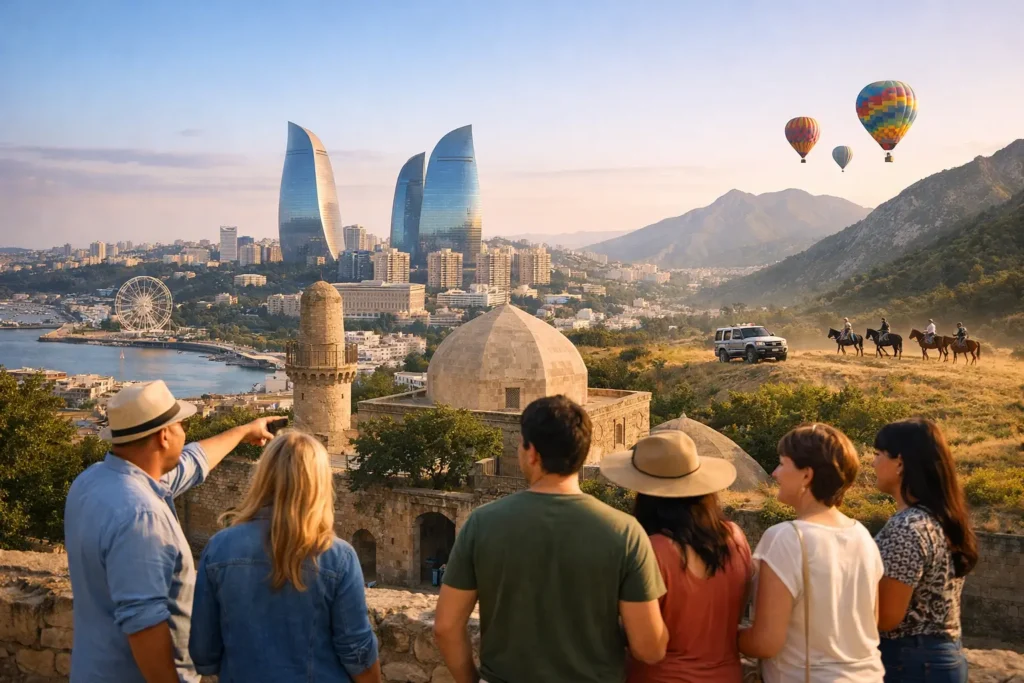
A 40-person incentive group arriving at Heydar Aliyev International Airport needs more than an attractive sightseeing plan. It needs coaches positioned to schedule, rooms released against a clear rooming list, guides matched to language needs, meal timings that work for the program, and one local operations team accountable from arrival through departure. The strongest top Azerbaijan experiences for groups are therefore the ones that combine destination impact with practical, repeatable delivery.
For travel agencies, tour operators, and MICE planners, Azerbaijan works best as a layered product. Baku provides a polished base for city programs, meetings, and gala events, while the Absheron Peninsula, Gobustan, and the mountain regions add distinctly different day and overnight experiences. The right combination depends on group profile, available nights, mobility requirements, and whether the program is leisure-led, incentive-led, or built around a conference.
Designing Top Azerbaijan Experiences for Groups
Azerbaijan should not be sold as a single fixed circuit. A three-night city break, a five-night leisure series, and a six-night incentive program require different pacing and operational design. For shorter programs, keeping Baku as the primary hub reduces hotel changes and protects time for high-value experiences. For longer stays, a regional overnight in Gabala, Shahdag, or Sheki creates stronger contrast and gives clients a sense of journey.
The most successful group itineraries balance scheduled highlights with protected transition time. A drive that looks short on a map still requires coach loading, comfort stops, photo opportunities, and coordinated restaurant service. Building these details into the proposal is what keeps a premium group program feeling controlled rather than rushed.
1. Baku Old City and contemporary landmarks
Baku is the natural opening chapter for most inbound groups. A professionally guided city program can pair the historic lanes of Icherisheher, the Palace of the Shirvanshahs, and the Maiden Tower area with the city’s broad boulevards and contemporary architecture. This contrast is commercially useful: it gives first-time visitors recognizable heritage, strong visual content, and a modern capital-city experience in one day.
For series groups, the city tour can be delivered as a focused half-day orientation or expanded with a waterfront walk, museum visit, local craft stop, and hosted dinner. For incentives, private access arrangements, timed arrivals, and a venue-based evening can elevate the same core route without adding unnecessary complexity.
2. Gobustan and mud volcanoes as a full-day contrast
The Gobustan route is one of the clearest ways to move a group beyond the urban skyline. Rock art landscapes and the unusual mud volcano setting create a memorable contrast with Baku, particularly for guests who have limited experience of the Caucasus. It is also an efficient extension when planned with appropriate vehicles, guide briefing, and a well-timed lunch arrangement.
This program suits leisure groups and incentives, but the exact transport format matters. Standard coaches are efficient for the main touring portions, while the final approach to the mud volcano area is best organized with suitable local vehicles. A DMC should define this operational split in advance, rather than treating it as an on-the-day adjustment.
3. Absheron heritage: Ateshgah and Yanar Dag
The Absheron Peninsula adds a compact cultural route that fits particularly well into four-night Baku programs. Ateshgah Fire Temple and Yanar Dag are generally paired as heritage-focused visits, supported by clear interpretation from a licensed guide. The route works well for groups that want a meaningful excursion without committing to a long intercity day.
It can also be scheduled strategically around conference sessions or late arrivals. For MICE planners, that flexibility is valuable: participants can attend a morning meeting, take an afternoon cultural excursion, and return in time for an evening function. The experience feels complete while keeping the program close to the main hotel base.
4. A Caspian-facing evening in Baku
Not every group highlight needs to be a full excursion. A well-produced Baku evening can become a key program moment, especially after a long arrival day or formal business agenda. Options may include a private dinner in a suitable venue, a themed cultural performance, or a hosted reception with views across the city and Caspian waterfront.
The commercial value lies in how the evening is managed. Menu selection should reflect dietary requirements collected before arrival, transfer timings should be aligned with the event flow, and a dedicated operations contact should remain available until the group returns to the hotel. These details protect the agency’s client experience as much as the venue itself.
5. Gabala, Nohur Lake, and a regional overnight
Gabala provides a natural green and mountain-oriented counterpoint to Baku. A route incorporating Nohur Lake, scenic stops, and resort-style accommodation can turn a standard city itinerary into a wider Azerbaijan circuit. It is especially suited to groups with five nights or more, where the regional overnight creates value without forcing an overly compressed schedule.
This is a program where hotel contracting and room allocation become central. Operators should confirm the preferred room mix early, particularly when the group includes twins, doubles, singles, and family configurations. Early planning also allows the DMC to select the most appropriate dining layout and coach movement plan for the property.
6. Shahdag or Tufandag for active incentives
Mountain resort experiences at Shahdag or Tufandag are effective for active incentive groups, leadership retreats, and mixed-age leisure groups seeking a different pace. Depending on the season and group profile, the program can emphasize cable-car views, light outdoor activities, resort facilities, or simply a scenic highland stay with a carefully planned dinner event.
The choice between Shahdag and Tufandag should be based on the wider routing, hotel availability, meeting requirements, and the desired program character. A strong proposal will not present them as interchangeable. It will explain which option supports the client’s itinerary, transfer pattern, and event objectives more effectively.
7. Shamakhi and Ismayilli on a scenic circuit
For groups traveling between Baku and Gabala, Shamakhi and Ismayilli make the journey part of the experience rather than a transfer day to be endured. The route can include cultural heritage, countryside landscapes, and a lunch stop that breaks the drive into manageable sections. This format is particularly useful for operators building escorted series departures or private group circuits.
The key is restraint. Trying to include every roadside stop can weaken the day and create delays at the hotel. A better approach is to select two or three well-paced experiences, reserve time for comfort breaks, and arrive at the regional property with enough time for check-in and an unhurried evening service.
8. Sheki as a heritage extension
Sheki is a strong addition for groups with sufficient time for a deeper cultural route. Its historic character, including the Khan’s Palace, gives an itinerary a different visual and narrative dimension from Baku. It is best positioned as part of a multi-day western circuit rather than added to a short break simply to increase the number of destinations.
For longer programs, Sheki can combine well with Gabala or be handled as a separate overnight depending on the group’s pace. This is where detailed routing, realistic drive-time planning, and regional hotel knowledge make a measurable difference to both guest satisfaction and tour profitability.
Building a Group Program That Operates Cleanly
The destination experience is only half of the product. Agencies and operators need a local partner that can convert a concept into a controlled operation. That begins with a clear quotation: hotel category and board basis, transport type and capacity, guide languages, included sightseeing, meal requirements, and any MICE-specific production elements should be defined before confirmation.
For larger groups, operational planning should also address arrival flight patterns, airport meet-and-greet staffing, baggage handling coordination where required, coach rotation, guide allocation, and a named escalation contact. For conferences and incentives, the same discipline extends to meeting-room layouts, audiovisual requirements, branding points, gala production, and off-site event transfers.
There is no universal best itinerary. A student group may prioritize educational context and moderate pacing; a corporate incentive may require premium dining and high-impact event moments; a traditional leisure series may need dependable daily inclusions and efficient rooming-list management. The proposal should reflect these differences rather than forcing every group into the same template.
Brilliant Travel supports agencies, operators, and MICE planners with tailored Azerbaijan programs, multilingual guides, hotel coordination, transport logistics, and full itinerary execution. The practical objective is straightforward: give partners a destination product they can sell confidently while keeping operational responsibility in capable local hands.
The most effective Azerbaijan group programs leave room for the unexpected photo stop, the unhurried meal, and the genuine local story – because the timetable, transport, accommodations, and on-site coordination have already been handled with care.